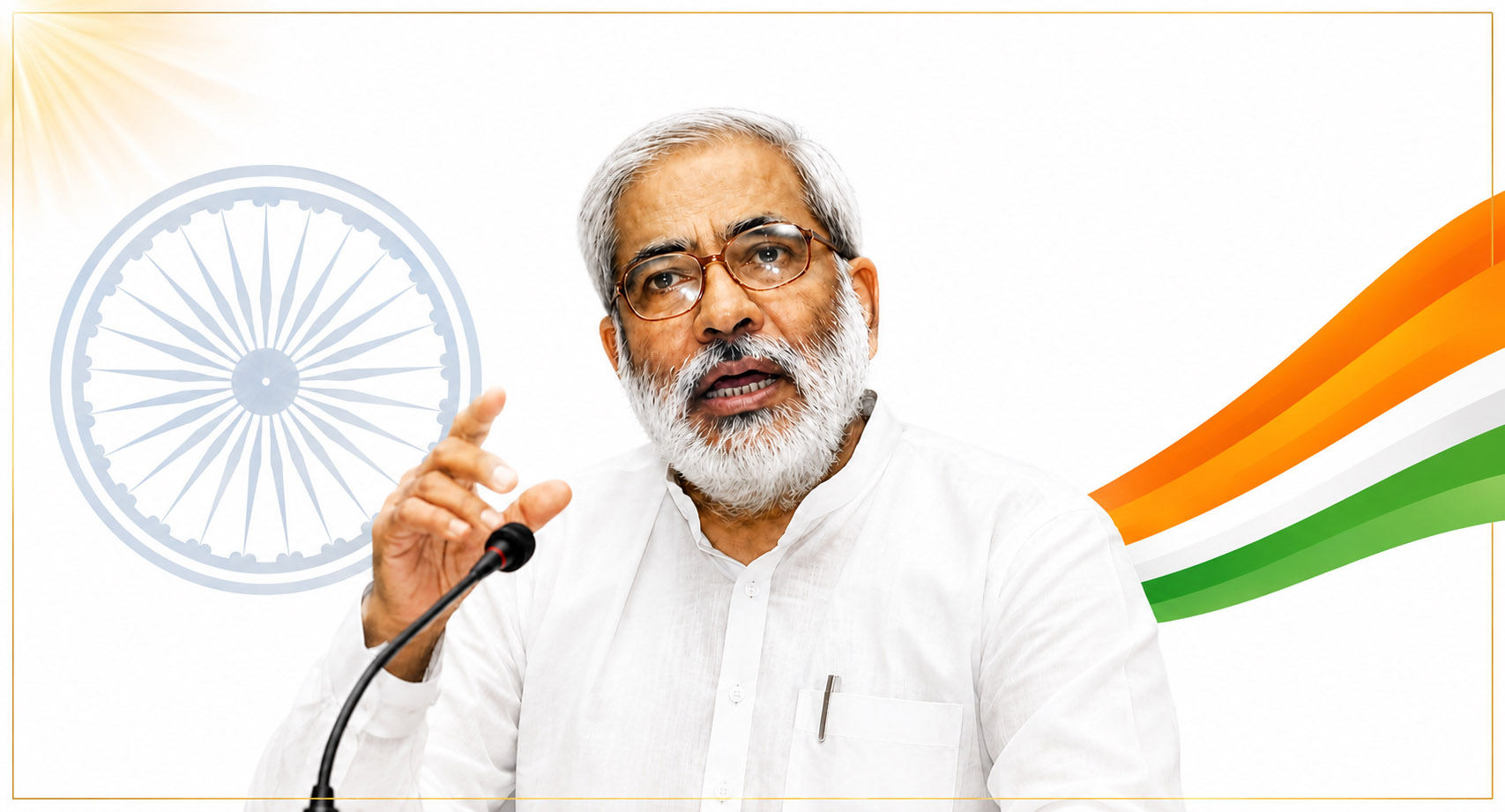
Founder Patron, Confederation of NGOs of Rural India (CNRI)
The Profile
Dr. Raghuvansh Prasad Singh (1946–2020) was one of India’s finest statesmen — a socialist visionary, an eminent parliamentarian, a mathematician-turned-policymaker, and an unwavering champion of rural India. Across four decades of public life he was admired across party lines for his integrity, simplicity and intellectual depth, treating politics not as a pursuit of power but as a lifelong mission of national service. For the Confederation of NGOs of Rural India (CNRI), he was far more than its Founder Patron — he was the architect of its guiding philosophy.
Born in rural Bihar and holding a Ph.D. in Mathematics, Dr. Singh brought analytical rigour to public life and a first-hand understanding of the challenges faced by farmers, labourers and marginalised communities. Shaped by the ideals of Gandhi, Lohia and Jayaprakash Narayan, he entered politics convinced that democracy could only flourish when the last person in society was empowered with dignity, opportunity and a voice. From his legislative career in Bihar to five consecutive terms in the Lok Sabha from Vaishali (1996–2014), and as Union Cabinet Minister for Rural Development (2004–2009), he left an indelible mark on India’s development landscape.
He is remembered nationally as the “NREGA Man of India.” As the principal architect and defender of the Mahatma Gandhi National Rural Employment Guarantee Act (MGNREGA), he redefined development itself — recasting employment from a welfare measure into a legal entitlement. The programme became one of the world’s largest rights-based public employment initiatives, strengthening village infrastructure, advancing water conservation, creating durable community assets and restoring the dignity of rural labour.
Yet his most enduring conviction was faith in the power of civil society. Long before “collaborative governance” became a fashionable phrase, he argued that governments may frame policies and allocate resources, but real development depends on the participation, trust and ownership of local communities. Civil society organisations, he held, are the bridge between policy and people — the guarantors of transparency, accountability and genuine participation. That conviction led him to CNRI, and it became CNRI’s founding idea.
Even at the height of his career he remained strikingly simple, honest and accessible — a leader who never lost touch with the people he served. As statesman, institution-builder and the revered “NREGA Man,” Dr. Singh leaves a legacy that continues to guide all who believe a nation’s strength lies in empowered communities and ethical leadership.
His Legacy in CNRI
- He gave CNRI its founding idea. As Founder Patron, he envisioned CNRI as a national platform to unite credible voluntary organisations, strengthen cooperation between government and civil society, and promote community-led development rooted in India’s democratic values.
- He authored CNRI’s guiding philosophy. His belief that civil society must act as a constructive partner in governance, a catalyst for social transformation, and a guardian of democratic participation remains the intellectual core of the Confederation’s mission.
- He defined CNRI’s model of collaborative development. His vision of government, civil society, cooperatives, Panchayati Raj Institutions, academia, farmers’ organisations, women and youth working as equal partners became the cornerstone of CNRI’s institutional character.
- He shaped CNRI as an empowering institution. Under his patronage, CNRI grew into a body committed to strengthening grassroots organisations, advancing participatory governance, influencing public policy and building people-centred partnerships.
- His patronage was never symbolic. He remained a constant source of intellectual guidance, moral inspiration and institutional encouragement — reminding CNRI that the true purpose of civil society is to serve the nation with integrity, professionalism and compassion.
Pull-quotes
“Governments can frame policies and allocate resources — but development succeeds only through the participation, trust and ownership of the people.”
“Civil society is the bridge between policy and people.”