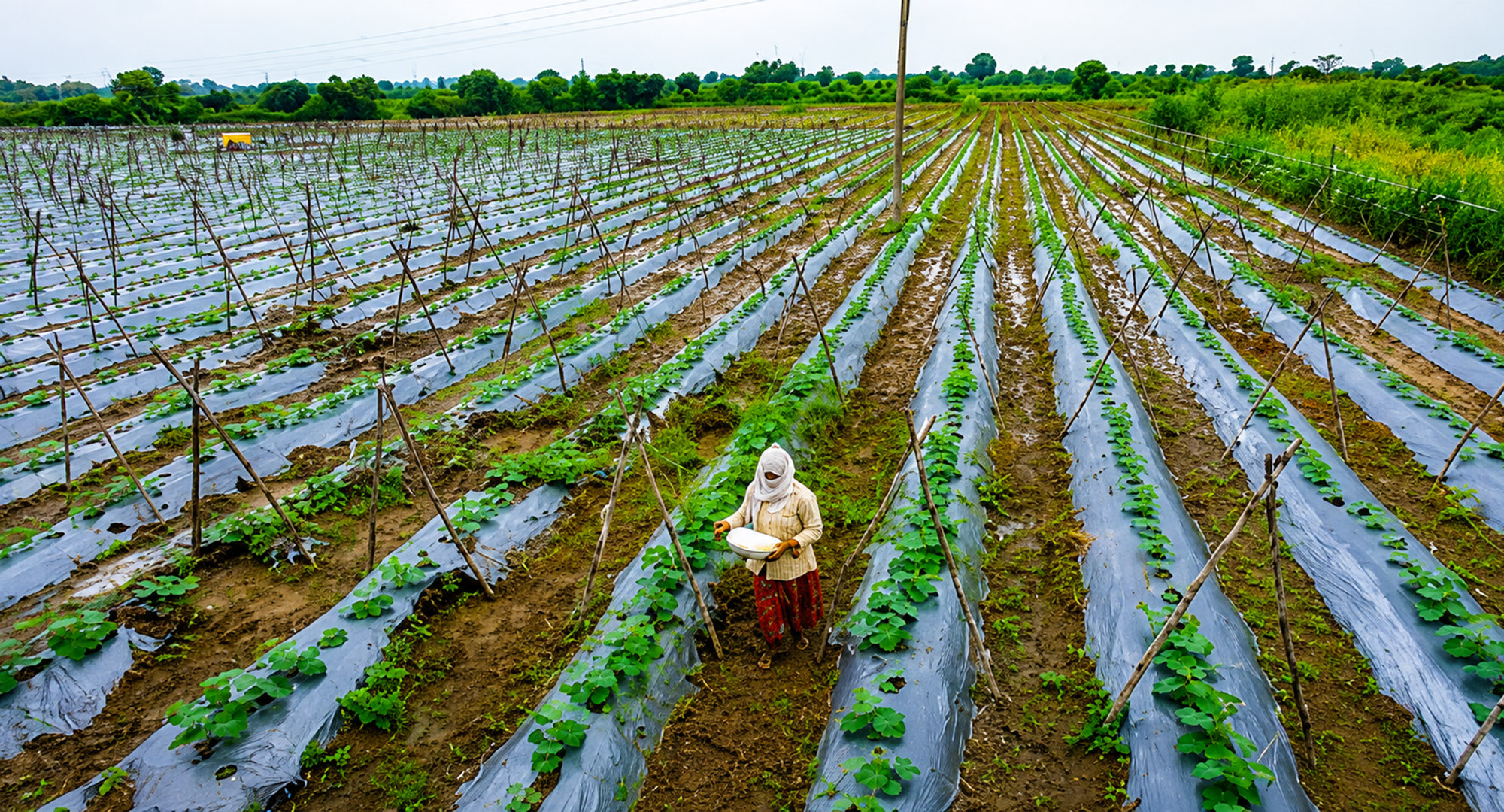
CNRI’s flagship concern is the farmer-centric value chain — moving the farmer from price-taker to stakeholder with market power. Locally, member NGOs organise farmers into FPOs, promote climate-smart and natural farming, and build market linkages that shorten the distance between field and buyer. Nationally, CNRI carries this experience into the MSP, crop-diversification and natural-farming policy conversations. Globally, it benchmarks Indian food systems against international standards on residues, safety and export competitiveness. Government works with CNRI as a partner in scheme design and last-mile testing. Self-reliant, heritage-rooted farming directly serves the Panch Pran of self-reliance and pride in heritage.Moving the farmer from price-taker to empowered stakeholder — the foundation of a self-reliant, food-secure Bharat.
Farmer-centric value chains, climate-smart farming, food and nutrition security, agri-entrepreneurship and market linkages.
How CNRI works.
- Local: member NGOs organise farmers into FPOs, promote natural and climate-smart farming, and build market linkages that shorten the field-to-buyer distance.
- National: CNRI carries grassroots experience into MSP, crop-diversification and natural-farming policy — including through the PM’s High-Power Committee.
- Global: benchmarking Indian food systems against international standards on residues, safety and export competitiveness.
CSRNAM & Panch Pran. Advances cooperative economic development and sustainable livelihoods (CSRNAM pillar 4); embodies self-reliance and pride in heritage through indigenous, natural farming (Prans 2 and 3).
Government hand in hand. CNRI’s members test schemes at the last mile and feed honest delivery data back into design; CNRI sits at the policy table where crop and price decisions are made.
Sankalp. A farming Bharat that feeds itself and the world, with prosperity flowing back to the farmer by 2047.