In the mid-2000s, tens of millions of rural and low-income Indian households lived a single misfortune away from destitution. The death of a breadwinner, an accident in the fields, or a sudden illness could erase years of painstaking saving and push an entire family below the poverty line. Formal insurance, designed for urban and salaried populations, rarely reached these households: premiums were unaffordable, the products were unfamiliar and intimidating, and the nearest branch might be a day’s journey away. Financial inclusion, in this context, was not a matter of convenience but of dignity, security, and survival.
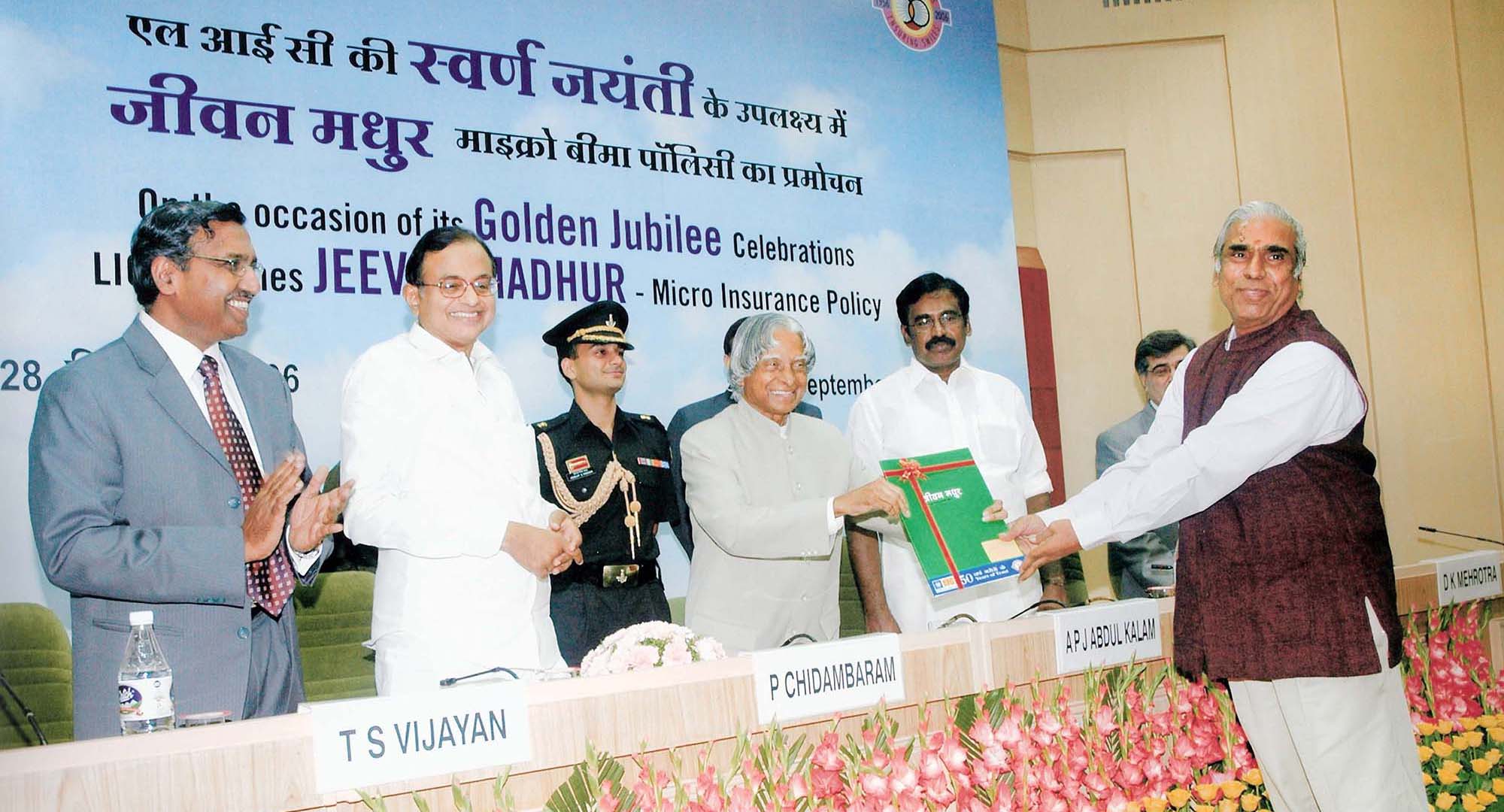
CNRI recognized early that the missing ingredient in rural insurance was not a product but trust. Its member NGOs were embedded in the very communities that formal institutions struggled to reach; they were known, credible, and permanently present, and villagers were willing to believe them where they would not believe a stranger with a form. By signing a landmark Memorandum of Understanding with the Life Insurance Corporation of India to implement the Jeevan Madhur Micro Insurance Scheme, CNRI converted this trust into working infrastructure — turning its nationwide network into a last-mile channel through which affordable insurance and social security could finally reach the households that needed it most.
The choice of micro-insurance as CNRI’s first major programmatic partnership was deliberate. It demonstrated, concretely and immediately, that the confederation was not merely an advocacy body but an organization that could deliver tangible protection to ordinary families. It also inaugurated a theme — financial inclusion — that would recur across the following decade, through pensions, Direct Benefit Transfers, and the JAM Trinity, each building on the credibility and the delivery model first established here.
| ACTION TAKEN |
- Executed a nationwide partnership with LIC. CNRI signed a formal Memorandum of Understanding with the Life Insurance Corporation of India to roll out the Jeevan Madhur micro-insurance product — a simple, low-premium life cover designed specifically for economically weaker sections and rural households outside the formal net.
- Mobilized member NGOs as trusted facilitators. Rather than relying on distant commercial agents, CNRI oriented and trained its member organizations to explain, enrol, and support policyholders. Because these NGOs already held the confidence of their communities, they could overcome the suspicion and unfamiliarity that had long kept insurance out of rural India.
- Ran grassroots awareness campaigns. Village-level drives explained the logic of pooling risk, the meaning of premiums and claims, and the real protection a modest policy could provide — building basic financial literacy alongside enrolment so that families understood what they were buying and why.
- Simplified the last mile of delivery. By embedding the scheme within an existing, trusted network, CNRI dramatically reduced the cost and friction of reaching dispersed rural households, making a genuinely inclusive product operationally viable where conventional distribution had failed.
- Built a repeatable delivery model. The programme established a template — public scheme plus grassroots network plus community trust — that CNRI would deploy again and again to carry financial services and welfare benefits to the excluded.
| IMPACT |
- Protection reached the previously excluded. Affordable life cover and social security were extended to weaker sections and rural families who had stood entirely outside the formal safety net, giving them a measure of resilience against sudden loss.
- The network proved itself as delivery infrastructure. The initiative demonstrated that CNRI’s members could serve as a credible, low-cost distribution channel for financial services — a lesson the confederation applied repeatedly in the years that followed.
- Civil society became a partner in inclusion. The partnership positioned the voluntary sector as an active collaborator of public financial institutions, not a bystander to the inclusion agenda, and showed regulators the value of grassroots reach.
- Financial literacy advanced. Alongside enrolment, communities gained a foundational understanding of insurance and risk — knowledge that made later financial-inclusion efforts easier and more effective.
- A decade of inclusion work was launched. Micro-insurance was the first in a sequence — pensions in 2011, the JAM Trinity in 2015 — that made financial inclusion a defining thread of CNRI’s identity and impact.
ENDURING SIGNIFICANCE
The 2006 partnership proved a principle that guided CNRI for two decades: that a trusted grassroots network can convert well-designed public schemes into real protection for real families. Trust, it turned out, was the missing infrastructure of financial inclusion — and CNRI supplied it. Just as importantly, the initiative showed that the confederation could move from vision to delivery, translating its founding promise into concrete security for households that the formal economy had long overlooked. It set the pattern for a decade of inclusion work and established CNRI’s reputation as an organization that gets tangible results at the last mile.