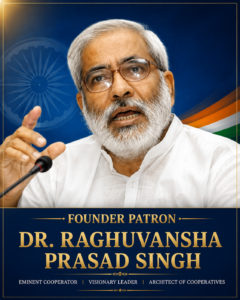
Dr. Raghuvansh Prasad Singh
Founder Patron, Confederation of NGOs of Rural India (CNRI)
Dr. Raghuvansh Prasad Singh (1946–2020) was one of India’s finest statesmen, a visionary socialist leader, an eminent parliamentarian, an academician, and an unwavering champion of rural India. Throughout a distinguished public life spanning more than four decades, he remained deeply committed to the ideals of social justice, participatory democracy, and inclusive development. Admired across political parties for his integrity, simplicity, and intellectual depth, Dr. Singh represented a rare tradition of public leadership where politics was viewed not as a pursuit of power but as a lifelong mission of national service. His humility, accessibility, and unwavering concern for the poorest sections of society earned him immense respect from political colleagues, civil society leaders, grassroots workers, and ordinary citizens alike.
Born in rural Bihar, Dr. Singh’s early life shaped his enduring understanding of India’s villages and the challenges faced by farmers, labourers, and marginalized communities. A brilliant scholar who earned a Ph.D. in Mathematics and served as a professor before entering politics, he brought analytical rigour and intellectual clarity to public policymaking. Inspired by the ideals of Mahatma Gandhi, Dr. Ram Manohar Lohia, and Lok Nayak Jayaprakash Narayan, he entered public life with the conviction that genuine democracy could only flourish when the last person in society was empowered with dignity, opportunity, and a meaningful voice in governance.
His political journey reflected an extraordinary blend of idealism and administrative excellence. Emerging from the Socialist movement and the historic Jayaprakash Narayan movement for democratic reforms, Dr. Raghuvansh Prasad Singh became one of the most respected political leaders of Bihar. Beginning his legislative career in 1977, he served the State in several important constitutional and ministerial positions, including Minister of State (Independent Charge) for Power, Deputy Speaker of the Bihar Legislative Assembly, Chairman of the Bihar Legislative Council, and Minister for Energy, Relief and Rehabilitation, and Official Language. His reputation as a thoughtful administrator and principled public servant soon established him as a national leader with a deep understanding of rural governance and development.
In 1996, he was elected to the Lok Sabha from Vaishali, Bihar, a constituency he represented for five consecutive terms until 2014. During his parliamentary career, he served in key ministerial responsibilities in the Government of India, including Animal Husbandry & Dairying, Food & Consumer Affairs, and most notably as the Union Cabinet Minister for Rural Development between 2004 and 2009. It was during this period that he left an indelible mark on India’s development landscape through policies that transformed the lives of millions of rural households.
Dr. Raghuvansh Prasad Singh will forever be remembered as the “NREGA Man of India.” As the principal architect and driving force behind the Mahatma Gandhi National Rural Employment Guarantee Act (MGNREGA), he helped redefine the country’s approach to rural development by recognizing employment as a legal entitlement rather than a welfare measure. His leadership in conceptualizing, implementing, and defending the programme made MGNREGA one of the largest rights-based public employment initiatives in the world. Beyond creating livelihood opportunities for millions of rural families, the programme strengthened village infrastructure, promoted water conservation, created durable community assets, and reinforced the dignity of labour. The affectionate title of “NREGA Man” reflected not merely his administrative leadership but his deep empathy for rural India and his unwavering belief that development must be people-centred and rights-based.
While his contributions as a policymaker are widely celebrated, Dr. Singh’s greatest strength lay in his profound faith in the power of civil society. Long before collaborative governance became a widely discussed concept, he believed that voluntary organizations were indispensable partners in nation-building. He often emphasized that governments could formulate policies and allocate resources, but the real success of development depended upon the participation, trust, and ownership of local communities. For him, civil society organizations served as the bridge between policy and people, connecting government initiatives with grassroots realities while ensuring transparency, accountability, and public participation.
It was this conviction that inspired him to become the Founder Patron of the Confederation of NGOs of Rural India (CNRI). He envisioned CNRI as a national platform that would unite credible voluntary organizations across the country, strengthen cooperation between government and civil society, and promote community-led development rooted in India’s democratic values. Under his patronage, CNRI emerged as an institution committed to empowering grassroots organizations, promoting participatory governance, influencing public policy, and fostering partnerships that placed people at the centre of development. His association with CNRI was never symbolic; he remained a constant source of intellectual guidance, moral inspiration, and institutional encouragement, always reminding the organization that the true purpose of civil society was to serve the nation with integrity, professionalism, and compassion.
Dr. Singh firmly believed that India’s future would be shaped not by government alone but by the collective efforts of government institutions, civil society organizations, cooperatives, Panchayati Raj Institutions, academia, farmers’ organizations, women, and youth working together as equal partners. This philosophy of collaborative development became the cornerstone of CNRI’s institutional character and continues to inspire its work in strengthening rural communities, promoting participatory governance, and advancing inclusive national development.
Even at the height of his political career, Dr. Raghuvansh Prasad Singh remained remarkably simple in his personal life. He was known for his humility, honesty, and accessibility, earning admiration across ideological divides as a leader who never lost touch with the people he represented. He believed that public office was a sacred trust and that leadership carried a moral responsibility to serve those who had the least voice in society. His integrity, compassion, and lifelong dedication to the welfare of rural India made him not only an exceptional political leader but also a moral force in India’s democratic journey.
For the Confederation of NGOs of Rural India, Dr. Raghuvansh Prasad Singh was far more than its Founder Patron—he was the architect of its guiding philosophy. His vision that civil society should function as a constructive partner in governance, a catalyst for social transformation, and a guardian of democratic participation continues to define CNRI’s mission. His life remains an enduring inspiration for all those who believe that the strength of a nation lies in empowered communities, ethical leadership, and active citizen participation. As a statesman, institution builder, champion of rural development, and the revered “NREGA Man of India,” Dr. Raghuvansh Prasad Singh leaves behind a legacy that will continue to guide generations committed to building a stronger, more inclusive, and self-reliant India.