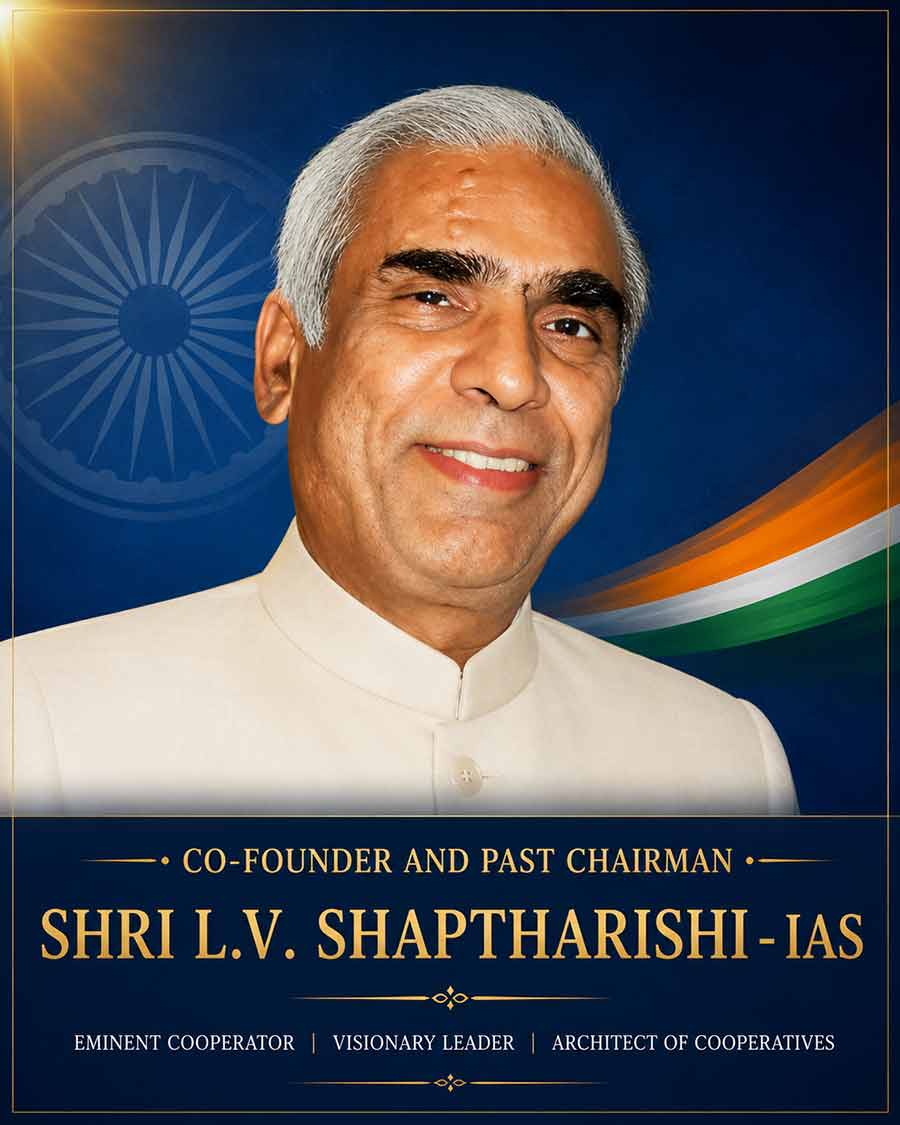
Shri L. V. Saptharishi, IAS
Co-Founder & Chairman
Confederation of NGOs of Rural India (CNRI)
Chairman: 15 October 2013 – 5 February 2015
Distinguished Civil Servant | Institution Builder | Champion of Participatory Governance
Entrusted by the Election Commission of India as the Special Observer for the landmark 2004 Lok Sabha Elections in Bihar, Shri L. V. Saptharishi, IAS, is one of India’s most distinguished civil servants, institution builders, and champions of participatory governance. A senior officer of the Indian Administrative Service (West Bengal Cadre), he devoted over three decades to exemplary public service, earning national recognition for his impeccable integrity, visionary leadership, and outstanding contributions to public administration, rural development, international trade, industrial policy, textiles, fashion, and democratic governance. During his illustrious career, he held several of the highest positions in the Government of India, including Secretary to the Government of India & Director General, Council for Advancement of People’s Action and Rural Technology (CAPART), Ministry of Rural Development, Additional Secretary & Director General (Anti-Dumping), Ministry of Commerce & Industry, Director General, National Institute of Fashion Technology (NIFT), and Joint Secretary, Ministry of Textiles. He is also the Founder Chairman of the Fashion Design Council of India (FDCI) and a Founder Member of the International Foundation of Fashion Technology Institutes (IFFTI), making pioneering contributions to India’s creative economy and global design ecosystem. As Co-Founder and Chairman of the Confederation of NGOs of Rural India (CNRI) from 15 October 2013 to 5 February 2015, he provided visionary leadership that strengthened CNRI into one of India’s foremost national platforms for civil society, participatory governance, and rural transformation. Widely admired for his ethical leadership, institution-building capabilities, and unwavering commitment to nation-building, Shri Saptharishi’s enduring legacy continues to inspire generations of public administrators, policymakers, and civil society leaders.
Architect of Government–Civil Society Partnership
Shri L. V. Saptharishi has been one of India’s foremost advocates of participatory governance and collaborative development. Long before Government–Civil Society partnership became an accepted model of governance, he championed the belief that sustainable national progress can only be achieved when governments, voluntary organizations, cooperatives, academic institutions, private enterprises, and local communities work together with a shared sense of purpose and responsibility.
This philosophy found enduring institutional expression through the Confederation of NGOs of Rural India (CNRI), where he served as Co-Founder and Chairman from 15 October 2013 to 5 February 2015. His leadership marked a defining phase in CNRI’s evolution into one of India’s most respected national platforms representing voluntary organizations committed to rural development, policy advocacy, social innovation, community empowerment, and participatory democracy.
Under his stewardship, CNRI strengthened its institutional framework, expanded its national outreach, deepened engagement with policymakers, and emerged as a trusted bridge between Government and Civil Society. He envisioned CNRI not merely as a federation of NGOs, but as a national movement dedicated to empowering civil society as an indispensable partner in India’s development journey.
Secretary to the Government of India & Director General, CAPART
One of the defining milestones of Shri Saptharishi’s distinguished career was his appointment as Secretary to the Government of India and Director General of the Council for Advancement of People’s Action and Rural Technology (CAPART), Ministry of Rural Development.
During his tenure, CAPART became a catalyst for strengthening Government–Civil Society collaboration across the country. He promoted innovative approaches to rural technology, sustainable livelihoods, watershed development, women’s empowerment, capacity building, community participation, and grassroots institution building. His leadership reinforced the role of voluntary organizations as trusted partners in implementing development programmes and empowered thousands of grassroots institutions to contribute meaningfully to rural transformation.
Guardian of Democratic Values
Among the highest recognitions of his distinguished public service was his appointment as Special Observer of the Election Commission of India for the 2004 Lok Sabha Elections in Bihar. This prestigious constitutional responsibility was entrusted to him at a time when Bihar faced one of the most challenging electoral environments in the country.
His selection reflected the Election Commission’s complete confidence in his impartiality, administrative wisdom, integrity, and ability to ensure free, fair, transparent, and peaceful elections. This assignment remains a defining symbol of the trust reposed in him by one of India’s most respected constitutional institutions.
Leader in International Trade and Economic Policy
As Additional Secretary to the Government of India and Director General (Anti-Dumping), Ministry of Commerce & Industry, Shri Saptharishi played a significant role in strengthening India’s trade defence mechanisms and protecting domestic industries against unfair international trade practices. His work contributed to reinforcing India’s position in the evolving global trading system while safeguarding national economic interests.
Pioneer of India’s Fashion and Creative Economy
Beyond traditional governance, Shri Saptharishi emerged as one of the principal institution builders of India’s fashion and design sector.
As Director General of the National Institute of Fashion Technology (NIFT), he strengthened India’s premier institution for fashion education and design excellence.
Recognizing the need for a representative industry body, he became the Founder Chairman of the Fashion Design Council of India (FDCI), an institution that has played a transformative role in promoting Indian fashion globally, nurturing design talent, and positioning India as an international fashion destination.
His global vision was further reflected in his role as a Founder Member of the International Foundation of Fashion Technology Institutes (IFFTI), fostering international collaboration among leading fashion and design institutions worldwide.
Leadership in the Textile Sector
As Joint Secretary, Ministry of Textiles, Shri Saptharishi contributed to policy formulation, modernization of the textile industry, export promotion, technological advancement, and skill development, strengthening one of India’s most important employment-generating sectors.
International Development Leadership
Shri Saptharishi’s expertise extended beyond India through his role as National Programme Manager (UNDP) for the Jute Sector, where he promoted sustainable development, value addition, and modernization within India’s jute industry.
He also served as an International Consultant to several prestigious multilateral organizations, including the Common Fund for Commodities (CFC), Food and Agriculture Organization (FAO), United Nations Conference on Trade and Development (UNCTAD), International Jute Organization (IJO), Swiss Development Cooperation (SDC), and the International Trade Centre (ITC), Geneva, contributing to international initiatives on trade, commodities, rural development, institutional strengthening, and sustainable economic growth.
Distinguished Leadership in West Bengal
Before assuming national leadership positions, Shri Saptharishi built an exceptional administrative record in the Government of West Bengal.
As District Collector & District Magistrate, Nadia, he earned appreciation for responsive administration, development planning, and people-centric governance.
He later served as Officer on Special Duty, Falta Export Processing Zone, while also holding the office of Joint Secretary, Department of Commerce & Industry, where he played a key role in promoting exports, industrial investment, and economic development.
His subsequent appointments as Advisor, Industry & Commerce, West Bengal Industrial Development Corporation (WBIDC) and Divisional Commissioner, Jalpaiguri Division further demonstrated his administrative versatility and leadership across governance, industrial development, and regional administration.
An Extraordinary Institution Builder
Few public servants have contributed to institution building across such a wide spectrum of national life. From rural development and public administration to international trade, textiles, fashion, education, and civil society, Shri Saptharishi consistently created institutions founded on integrity, professionalism, innovation, and excellence.
His legacy extends beyond the offices he held; it lives through the institutions he strengthened, the leaders he mentored, and the systems he established to serve the nation.
A Mentor and Inspiration to the CNRI Family
Within the CNRI fraternity, Shri L. V. Saptharishi is remembered not merely as a Chairman but as a mentor, philosopher, guide, and inspiration. His humility, wisdom, constitutional values, and unwavering belief in the transformative power of civil society inspired thousands of voluntary organizations and development professionals across India.
He encouraged a generation of social leaders to uphold the highest standards of integrity, transparency, professionalism, and national commitment. His leadership continues to shape CNRI’s culture of ethical governance, constructive engagement, and collaborative nation-building.
A Legacy that Continues to Inspire
The life and work of Shri L. V. Saptharishi represent the highest traditions of the Indian Administrative Service. His extraordinary journey—from District Magistrate to Secretary to the Government of India, from constitutional responsibilities entrusted by the Election Commission to global assignments with international organizations, and from pioneering national institutions like FDCI and NIFT to leading CAPART and co-founding CNRI—reflects a lifetime dedicated to public service and institution building.
For the CNRI family, Shri L. V. Saptharishi remains a visionary administrator, distinguished statesman, institution builder, and one of the foremost champions of Government–Civil Society partnership in modern India. His enduring legacy continues to inspire every member of CNRI to uphold the ideals of participatory governance, ethical leadership, and inclusive nation-building, ensuring that his vision remains a guiding force for future generations.