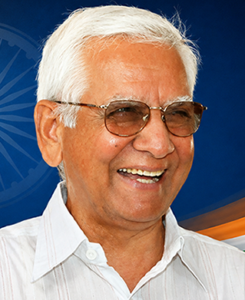
Shri Sompal Shastri
Chief Patron, Confederation of NGOs of Rural India (CNRI)
Former Union Minister of State for Agriculture | Former Member of Parliament | Distinguished Agricultural Economist, Policy Strategist & Rural Development Visionary
Shri Sompal Shastri is one of India’s most respected agricultural economists, statesmen, and public policy strategists, whose distinguished career spanning more than five decades has significantly influenced the country’s agricultural, rural development, and economic planning landscape. Widely admired for his scholarly approach to governance and his unwavering commitment to farmers’ welfare, he has consistently advocated policies that combine economic prudence with social justice, making him one of the foremost voices on rural transformation in India.
Born on 20 January 1942 in Kakor Kalan village of present-day Baghpat district, Uttar Pradesh, Shri Shastri inherited a strong tradition of public service from his father, Late Shri Raghuvir Singh Shastri, a distinguished parliamentarian. He completed his B.A. (Hons.) in Economics, M.A. in Economics, and LL.B. from the University of Delhi, acquiring a strong academic foundation that later shaped his reputation as one of India’s leading experts in agricultural economics and development policy.
His public life has been defined by an exceptional blend of scholarship, administrative competence, and political leadership. Elected to the 12th Lok Sabha from Baghpat, Uttar Pradesh, Shri Sompal Shastri earned wide respect in Parliament for his insightful contributions on agriculture, food security, rural infrastructure, irrigation, cooperative development, fiscal policy, and economic reforms. His speeches and policy interventions reflected a deep understanding of the structural challenges confronting Indian agriculture and the need for long-term institutional reforms.
As the Union Minister of State for Agriculture in the Government of Prime Minister Shri Atal Bihari Vajpayee, Shri Shastri played a pivotal role in advancing agricultural modernization, promoting scientific farming practices, strengthening agricultural research and extension services, and encouraging sustainable resource management. He consistently emphasized increasing farm productivity, improving irrigation efficiency, conserving natural resources, expanding access to modern technology, and enhancing the economic resilience of small and marginal farmers. His tenure contributed to strengthening India’s agricultural policy framework during a crucial period of economic transition.
One of Shri Shastri’s most significant contributions has been his work in national economic planning. As a Member of the Planning Commission of India, he participated in the formulation of long-term national strategies relating to agriculture, rural infrastructure, employment generation, poverty alleviation, watershed development, natural resource management, and balanced regional growth. His analytical approach and deep understanding of rural economics enabled him to bridge the gap between policy formulation and grassroots implementation.
He later served as the Vice Chairman of the Madhya Pradesh State Planning Board, where he provided strategic direction for integrated rural development, infrastructure expansion, agricultural diversification, and decentralized planning. His recommendations helped strengthen policy frameworks that promoted inclusive growth and improved rural livelihoods.
Throughout his career, Shri Sompal Shastri has served on several national committees, advisory bodies, expert groups, and academic forums dealing with agriculture, water resources, rural development, food security, and economic policy. He has consistently advocated evidence-based policymaking, sustainable agriculture, climate resilience, efficient water management, agroforestry, and the empowerment of rural communities. His ability to integrate economic analysis with practical governance has earned him recognition as one of India’s foremost thinkers on agrarian policy.
Among his many achievements, Shri Shastri is widely acknowledged for:
- Providing visionary leadership in shaping India’s agricultural and rural development policies.
- Making significant contributions to national economic planning through the Planning Commission of India.
- Championing sustainable agriculture, efficient water management, and scientific farming practices.
- Promoting policies that strengthened agricultural research, extension systems, and farmer-oriented governance.
- Advocating balanced regional development and inclusive economic growth through decentralized planning.
- Serving as a respected mentor, policy advisor, and public intellectual on issues relating to agriculture, rural development, and economic governance.
- Contributing extensively to national debates on food security, natural resource conservation, and long-term agricultural sustainability.
Beyond public office, Shri Sompal Shastri has remained deeply engaged with academic institutions, research organizations, farmers’ groups, and civil society networks. His lectures, policy papers, and public engagements continue to guide discussions on agricultural reforms, cooperative development, climate-resilient farming, and rural prosperity. He is widely regarded as a bridge between policymakers, researchers, farmers, and civil society organizations.
As the Chief Patron of the Confederation of NGOs of Rural India (CNRI), Shri Sompal Shastri provides invaluable intellectual guidance, strategic direction, and moral leadership to one of India’s largest networks of voluntary organizations dedicated to rural development. His vast experience in governance and public policy has strengthened CNRI’s efforts to promote participatory development, community empowerment, sustainable livelihoods, and constructive engagement between government and civil society. His association with CNRI reflects his enduring belief that voluntary organizations are indispensable partners in achieving inclusive development and realizing the vision of a self-reliant and empowered rural India.
A statesman of rare integrity, an accomplished economist, and a lifelong advocate of farmers and rural communities, Shri Sompal Shastri continues to inspire generations of policymakers, development practitioners, and civil society leaders. His legacy is defined by his commitment to ethical public service, evidence-based policymaking, agricultural transformation, and the pursuit of an equitable, prosperous, and sustainable India. His contributions to national planning, agricultural policy, and rural development remain an enduring source of inspiration for all those committed to nation-building.